There’s an uncomfortable truth hiding inside the performance world of trading:
A huge percentage of traders who believe they’re “optimizing performance” are actually optimizing for emotional highs.
They don’t realize it. They’re sincere. They’re working hard.
But they’re solving the wrong problem.
And if you optimize the wrong variable long enough, you eventually get exactly what you optimized for.
The uncomfortable question most traders never ask
If you stripped away the P&L and watched your trading day like a scientist watching lab rats…
What behaviors are you reinforcing?
Excitement?
Urgency?
Adrenaline?
Stimulation?
Relief?
Euphoria?
Or calm execution, patience, and boring repetition?
Because the brain doesn’t reward profitability. It rewards stimulation.
And markets are one of the most powerful stimulation machines ever created.
The dangerous confusion: performance vs reward
Traders constantly blur two completely different systems:
System 1 — Performance optimization Built on learning, discipline, emotional regulation, and process mastery.
System 2 — Dopamine optimization Built on novelty, anticipation, urgency, uncertainty, and emotional swings.
The tragedy is this:
The second system feels like the first one.
It feels productive.
It feels motivating.
It feels like engagement.
It feels like you’re “in the zone.”
But neurologically, you’re just chasing stimulation.
nd markets deliver stimulation at industrial scale.
Dopamine isn’t pleasure. It’s pursuit.
Modern neuroscience has dismantled a huge myth: dopamine is not the “happiness chemical.”
It’s the wanting chemical.
Dopamine spikes when:
-
Something might happen
-
Something uncertain appears
-
A reward could be near
-
A threat could be near
-
Something novel appears
-
Progress feels possible
Notice what’s missing?
Actual success.
Your brain becomes chemically excited during the chase, not the outcome.
This is devastating for traders because the chase is everywhere:
-
Waiting for entries
-
Watching price move
-
Seeing P&L fluctuate
-
Anticipating the next trade
-
Experiencing volatility
You can lose money and still get dopamine.
Read that again.
You can lose money and still get dopamine.
This is why trading addiction exists.
This is why overtrading exists.
This is why revenge trading exists.
Your nervous system is being rewarded regardless of profitability.
Markets are a perfect dopamine machine
Dopamine neurons fire strongest for:
-
Novelty
-
Surprise
-
Uncertainty
-
Threat
-
Intermittent rewards
If you designed a casino in a lab to hijack human motivation, you’d build financial markets.
Every candle is new information.
Every tick is uncertainty.
Every trade is intermittent reward.
Every loss is threat.
Every win is variable reinforcement.
This is the same reinforcement schedule used in slot machines.
Your brain doesn’t know you’re trying to be a professional. It just knows you found a stimulation goldmine.
The emotional rollercoaster loop
The dopamine cycle has a brutal pattern:
-
Anticipation spike
-
Emotional peak
-
Chemical crash
-
Craving for the next spike
This creates the classic trader cycle:
Big win → euphoria → overconfidence → overtrading
Big loss → frustration → revenge → overtrading
Flat day → boredom → forced trades
Every path leads back to stimulation seeking.
Meanwhile the trader believes they’re “working hard.”
They are working hard. Just not toward performance.
Why excitement is the enemy of consistency
Elite performance research shows something traders hate to hear:
Peak performance happens at moderate arousal, not high arousal.
Too little stimulation → boredom
Too much stimulation → anxiety and impulsivity
Optimal performance → calm, focused engagement
The emotional intensity many traders crave sits outside the performance zone.
Professional trading becomes calmer as skill and discipline increase.
Which is exactly why many unconsciously resist it.
The real engine of sustained performance
Research consistently points to one driver of deep engagement:
Perceived learning progress.
Not profits.
Not adrenaline.
Not excitement.
Progress.
Humans stay engaged when they feel:
-
skills improving
-
feedback loops tightening
-
competence increasing
-
mastery building
The best performers are addicted to improvement, not stimulation.
That difference changes everything.
The hidden optimization most traders are running
Let’s be honest.
Many traders structure their environment around:
-
constant chart watching
-
constant information intake
-
constant position exposure
-
constant emotional feedback
-
constant P&L checking
This is not performance measurement.
This is an emotional stimulation architecture.
They are optimizing for:
-
frequent trades
-
emotional volatility
-
stimulation seeking
-
urgency
-
intensity
Then they wonder why discipline is fragile.
You built a system that rewards impulsivity.
The performance vs dopamine checklist
Look at these two columns carefully.
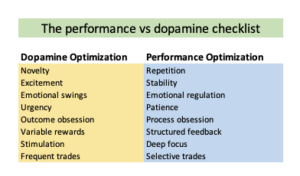
Most traders live in the left column while trying to achieve the right column.
That mismatch creates chronic frustration.
Why discipline feels so hard
Here’s the part that stings:
You’re not weak.
You’re not broken.
You’re not lacking willpower.
You’re fighting biology inside an environment engineered to defeat self-control.
Self-regulation is a trainable resource, but it fatigues under constant stimulation.
If your trading day is a nonstop dopamine buffet, discipline will always feel fragile.
You’re asking restraint to win against chemistry.
That’s not a fair fight.
What real performance optimization looks like
Real performance optimization is quiet, repetitive, and emotionally flat.
It looks like:
-
fewer trades
-
stricter rules
-
narrower focus
-
slower decision cycles
-
boring execution
-
deliberate practice
-
structured review
It feels underwhelming.
Which is exactly why it works.
The identity shift traders must make
The shift is simple, but not easy:
Stop optimizing for how trading feels. Start optimizing for how trading performs.
The market doesn’t pay for excitement. It pays for consistent execution and risk management
And execution thrives in environments that minimize emotional volatility, not maximize it.
The final uncomfortable truth
Most traders aren’t addicted to profits.
They’re addicted to how trading makes them feel.
And until that distinction becomes painfully clear, performance will always remain inconsistent.
Because you cannot simultaneously optimize for emotional highs and professional consistency.
Eventually, you must choose which system you want to serve.
The dopamine system. Or the performance system.
The market rewards only one of them.