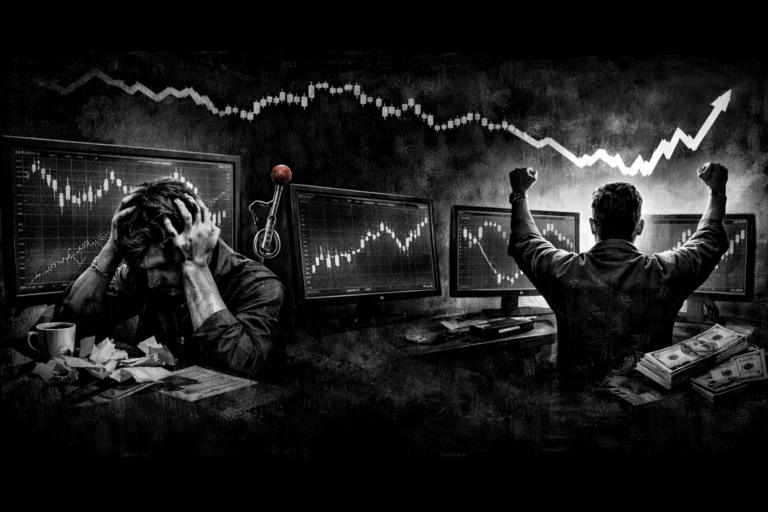

When people talk about trading psychology, the conversation usually goes in the wrong direction.
“Control your emotions.” “Don’t trade scared.” “Stay disciplined.”
Those statements aren’t completely wrong — but they miss the point.
Because all traders have emotions.
There is no level you reach where fear disappears. There is no experience threshold where stress no longer shows up. There is no amount of screen time that turns you into a robot.
Anyone who has traded long enough knows this.
The line of distinction between successful traders and everyone else is not the absence of emotion.
It’s the ability to maintain attentional control through the storm of emotions that inevitably arise.
Fear will show up. Excitement will show up. Doubt will show up. The urge to interfere will show up.
That part is unavoidable.
What separates traders is whether those emotions are allowed to hijack attention — or whether attention remains anchored to structure and context despite them.
We don’t rise above emotions by eliminating them. We rise above them by refusing to surrender control to them.
Emotion is information. Attention is authority.
And when attention remains intact, emotion no longer dictates behavior.
Why trading is uniquely brutal on the human brain
Trading is one of the most cognitively demanding things a human can do.
You are required to:
- make decisions under uncertainty
- process incomplete information
- manage real financial risk
- act quickly without confirmation
- accept irreversible outcomes
All of this happens while your nervous system is constantly scanning for threat.
From a biological standpoint, that matters.
The human brain did not evolve to calmly process ambiguity with money on the line. Uncertainty activates the same survival circuitry responsible for fight-or-flight responses.
This doesn’t mean you’re weak.
It means you’re human.
And when this circuitry activates, something very specific begins to degrade — not intelligence, not experience, but attention.
Attentional Control Theory (ACT): what actually breaks under pressure
Modern cognitive psychology explains this through Attentional Control Theory (ACT).
ACT shows that under anxiety or emotional load:
- working memory capacity decreases
- executive inhibition weakens
- goal-directed attention degrades
The brain shifts away from top-down control and toward bottom-up control.
In simpler terms:
Top-down attention is what allows you to follow a plan. Bottom-up attention is what pulls you toward whatever feels urgent in the moment.
Top-down attention:
- structure
- thesis
- time frame
- rules
- context
Bottom-up attention:
- fast candles
- sudden volatility
- PnL swings
- fear of giving back
- fear of missing out
As emotional arousal increases, the brain prioritizes immediacy over structure.
You don’t become irrational.
You become reactive.
And reactivity is simply attention without direction.
Skill doesn’t disappear — access to skill does
This is one of the most important distinctions a trader can make.
When things fall apart, you didn’t suddenly forget your strategy.
You didn’t lose intelligence.
You lost access.
Anxiety doesn’t remove competence — it reduces efficiency and control.
That’s why after the fact traders often say: “I knew better.” “I saw that coming.” “I shouldn’t have done that.”
You did know better.
You just couldn’t hold that knowledge in attention long enough to act on it.
That’s not a character flaw.
It’s an attentional failure.
The breakdown happens before behavior does
Most traders believe the sequence looks like this:
emotion → mistake → loss
In reality, it looks like this:
loss of attentional control → narrowed perception → impulsive behavior → mistake
By the time you recognize you’re tilted, your attentional system has already degraded.
Perception narrows. Time horizon shortens. Threat sensitivity increases.
You’re no longer operating from the same mental state you prepared from in the premarket.
At that point, willpower doesn’t help.
You can’t think your way out of a physiological state you didn’t notice coming online.
Interoceptive awareness: sensing the internal market
This is where interoception becomes critical.
Interoception is your ability to sense what’s happening inside your body:
- heart rate
- breathing
- muscle tension
- agitation
- fatigue
Most traders have very low interoceptive awareness.
They only notice internal states once they’re extreme.
But research shows something important.
A study of professional traders on a London trading floor found that those with greater accuracy in perceiving their own heartbeat were more profitable — and survived longer in the markets.
Not because they followed gut feelings.
But because they detected physiological instability earlier.
They noticed when their nervous system was drifting out of range before it showed up as poor decisions.
Earlier detection created choice.
Later detection created reaction.
Think about this the same way you think about orderflow
We spend countless hours trying to see beneath the surface of price.
Orderflow. Absorption. Imbalance. Acceptance and rejection.
We want to understand pressure building before price reacts.
Interoceptive awareness does the same thing internally.
Your body reacts before your behavior does.
Heart rate increases. Breathing shortens. Muscle tension rises.
These are early signals.
We lose agency and become reactive, losing the ability to take in the larger context of the market.
Most traders don’t see them — so the first signal they notice is the mistake itself.
By then, damage is already in motion.
What mindfulness actually trains (and what it doesn’t)
Mindfulness has been misunderstood because it’s often framed as emotional suppression or calmness.
That’s not its purpose.
Mindfulness is attentional training.
It develops:
- attentional stability
- attentional redirection
- inhibitory control
- interoceptive resolution
Each time attention drifts and you bring it back, you are strengthening the same executive mechanisms required to stay aligned with your plan under emotional pressure.
You’re not training peace.
You’re training control.
Important reality check
None of this fixes:
- bad strategy
- poor risk management
- undefined exits
- negative expectancy
Mindfulness does not turn bad trading into good trading.
It amplifies whatever structure already exists.
If your plan is vague, your exits emotional, and your risk oversized — awareness won’t save you.
But if your structure is sound, attentional control allows you to access that structure consistently.
That’s where the edge appears.
Five ways to attack this problem directly
These are practical, not theoretical.
1) Train attention deliberately
Attention is a skill — and like any skill, it weakens if untrained.
Simple daily practice of sustaining attention on a single anchor builds top-down control.
The rep isn’t staying focused.
The rep is noticing drift and returning.
That ability transfers directly to trading when attention gets pulled by noise or volatility.
2) Increase interoceptive resolution
Most traders experience only extremes.
Start noticing subtler signals:
- shallow breathing
- jaw tension
- chest tightness
- restlessness
- mental narrowing
These appear before impulsive behavior.
Earlier awareness equals more options.
Later awareness equals reaction.
3) Treat internal state as a risk variable
We analyze market regime every day.
Few traders analyze internal regime.
Before trading ask:
- Is my nervous system elevated?
- Is my attention scattered?
- Is my patience reduced?
If internal volatility is high, position size should reflect that.
Risk management applies to the operator as much as the instrument.
4) Use micro-resets to prevent attentional tunneling
Attention decays with time.
Short resets — posture changes, slow exhales, stepping away briefly — restore executive control.
These aren’t breaks from performance.
They preserve it.
5) Practice holding risk, not escaping it
Many traders struggle not because they take too much risk — but because they never practice holding it.
Size way down. One micro. Wide stop. Defined target.
Feel the discomfort. Notice the urge to flatten. Recognize it as protection, not instruction.
You’re teaching your nervous system that arousal does not equal danger.
That habituation is what keeps attention online under pressure.
Final thought
The goal of trading is not emotional control.
It’s attentional control.
Emotions will always be present. Stress will always arise. Doubt will always knock.
The question is whether attention remains anchored to structure when it does.
The traders who succeed long-term aren’t calmer than everyone else.
They simply:
- notice earlier
- correct faster
- and stay aligned longer
Attention is invisible — but it governs everything.
And once you understand that, trading stops being a battle against emotion and becomes a practice of self-awareness.